“Selling out is an accusation that is only leveled at certain artists. One Direction, Cher and Stephen King are immune from such critique. The notion of a sellout relies on the belief that particular artists owe something to their audiences or wider community; something that is incompatible with certain forms of commercial success. A change in style could be considered selling out, by switching your self-penned confessional folksy ballads for a synth-heavy pop sound, for instance, or by eschewing the art house cinema that built your reputation to direct a superhero movie.”
Kyle Thomas Hemingway: The ephemera edit
An ongoing digital archive of 1,212 items (and counting) proving that I read, I saw, and I actually paid attention.
Category is
-
The Mind Issue
-

The Technology Issue
“The promise of improved access and low-cost democratization sits uncomfortably alongside the fact that digital mental health has become a multibillion-dollar industry, according to an estimate by the American Psychiatric Association. Many of these apps are free, on the face of it, but at what cost?”
-

Disegno #31
“To not be able to go there for the opening is very difficult. On the other hand, it’s a building for the people of Hong Kong and it’s nice that they will be the most important people at the opening. This period is probably the first time in history where buildings are being opened without their architects present, and maybe that’s an opportunity. This is a strong sign to the community and the people of Hong Kong. ‘Here, this building is for you. Enjoy it.’”
-

Disegno #30
“I first saw the Bourse de Commerce, really saw it, in April of this year, but by that point I had been living in Paris for more than six years. I’d visited the Louvre of course, a minute or so stroll towards the river, and the Musée des Arts Decoratifs just down the street. I had seen shows at the Centre Pompidou, a few minutes to the east, and I had been, grudgingly, to the vast mall at Les Halles right next door many times when a trip to Muji was unavoidable. I’d even met friends after work at Iovine’s pizzeria one bitingly cold winter’s evening, almost directly opposite the Bourse’s grand entrance, but still, I’d never seen it. It was just one more pile of haughtily beautiful pale Parisian stonework that my eyes slid over and my brain failed to register.”
-
The Mediterranean Issue
“Filling personal spaces with purely decorative, cheaply made trinkets—or tchotchkes, knickknacks, bric-a-brac, junk—is as American as apple pie. ‘Over time, Americans have decided—as individuals, as members of groups, and as a society—to embrace not just materialism itself but materials with a certain shoddy complexion,’ writes author Wendy A. Woloson in her book Crap: A History of Cheap Stuff in America.”
-
The 10th Anniversary Issue
“Dance is associated with the emotional pinnacles of the human experience—love, joy, lust, art, insanity. Watching someone dance, or doing it ourselves, inspires emotions we struggle to access otherwise. This complicated relationship between movement and feeling is part of what makes us human. It makes sense, then, that artists and researchers working with robotics view the creation of a dancing robot as a meaningful tech frontier: How better to prove the skillful yet fundamentally unthreatening potential of humanoids than getting them to do the Mashed Potato?”
-

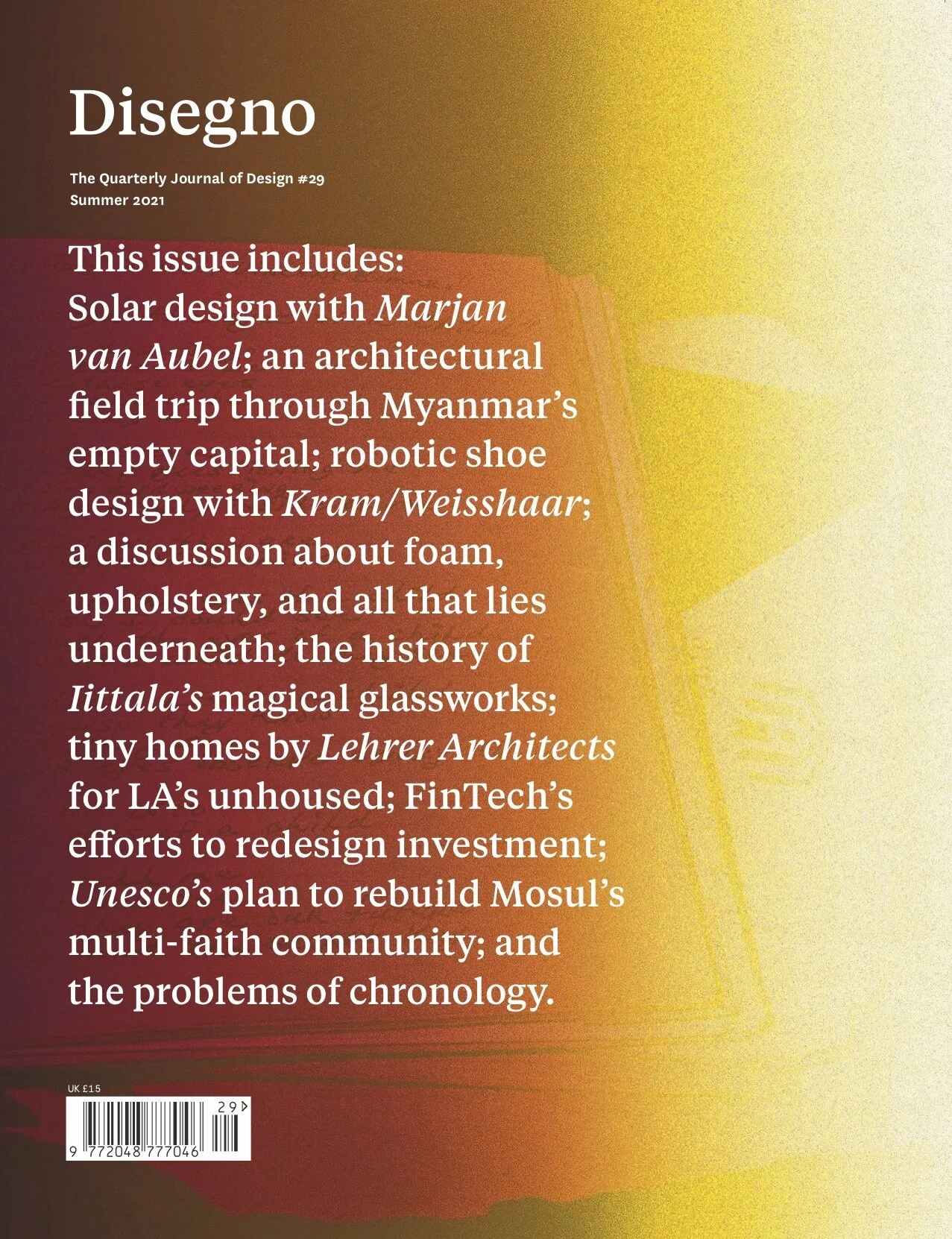
Disegno #29
“While some art forms seem well suited to be experienced in a digital format, furniture is a more challenging proposition—to state the obvious, its key function is to be physically used. The chairs we sit on, the desks we work at, the cupboards we store things in, the lamps we read by: while this transactional relationship is far from the only function furniture fulfils, it is the most common, even when furniture is sold at high prices at auction or via design galleries. Even Marc Newson’s Lockheed Lounge (the current record holder for the most expensive furniture object sold by a living designer at £2.4m) can be used for reclining—however tentatively one might choose to do so.”
-
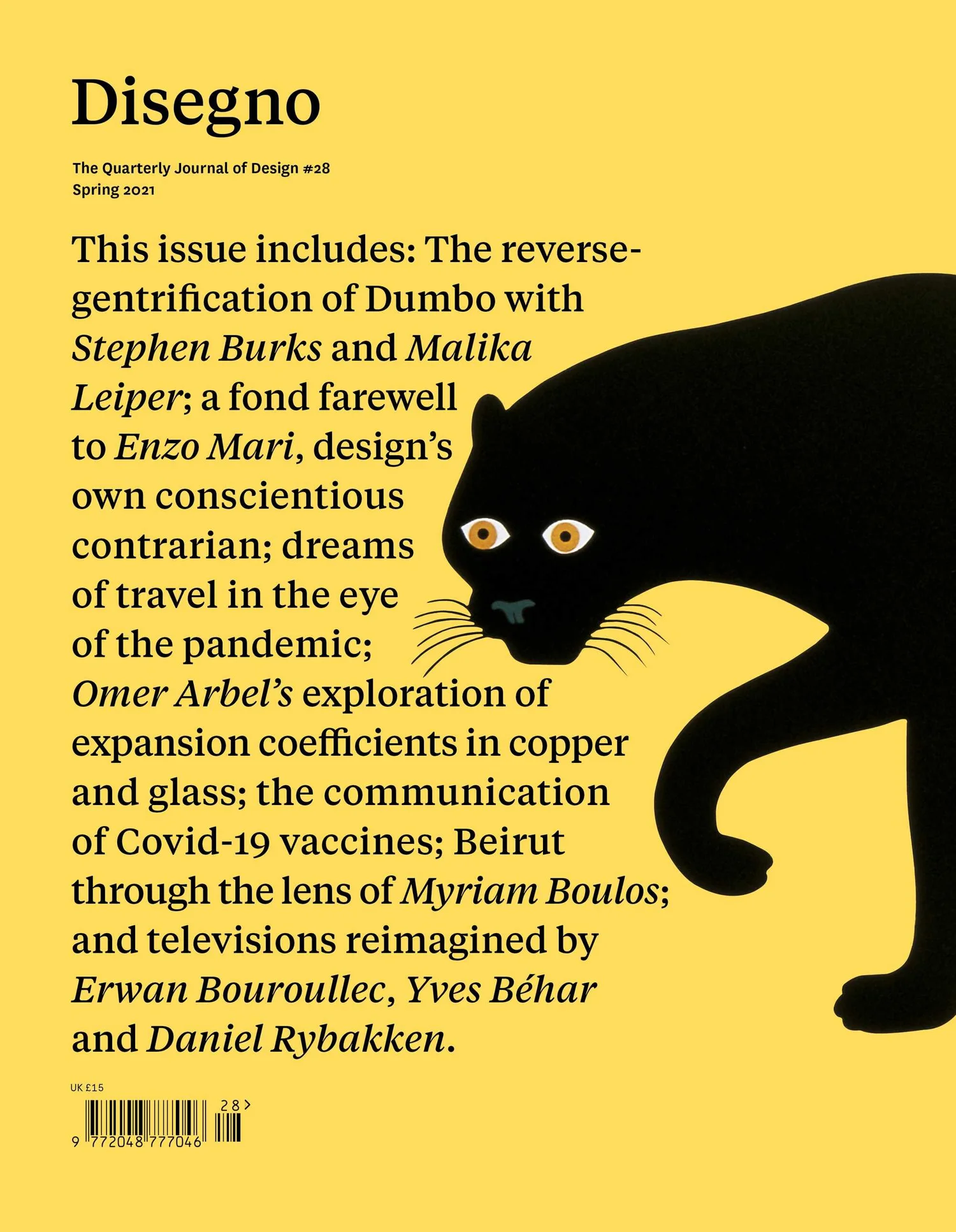
Disegno #28
“The staples of the fashion industry have not been immune. The fashion show, the launch and the press trip: all have been cancelled or reconsidered, like so many other events.”
-
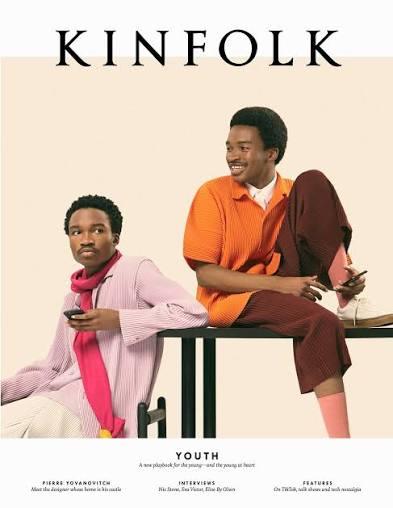
The Youth Issue
“Learning to take responsibility is an essential part of growing up, no matter who you are, and how we respond when we’re confronted with our past misdeeds (including our digital ghosts) is a show of character. So apologizing, while uncomfortable and embarrassing, is never a bad thing, not really. What matters most is how we proceed going forward.”
-
The Rituals Issue
“Rituals are the bedrock of our sense-making in this world. According to Nick Hobson and his colleagues at the University of Toronto, they help us regulate emotions, our goal/performance states, and our connection to other people. From the outside, rituals could look irrational or non-functional, because they do not make ‘logical’ sense. But rituals tell a story that can help us make sense of something, and move past it.”