“I see it as part of our role to help the next generation find their own voices. Everyone has to walk into the light themselves. That space of exploration is where new ideas emerge, and the more we stay open, the more able we are to find harmony. We live in a world full of extraordinary souls.” (Nick Cave)
Kyle Thomas Hemingway: The ephemera edit
An ongoing digital archive of 1,410 items (and counting) proving that I read, I saw, and I actually paid attention.
Category is
Magazine
-
-
“In the 20th century, Hans-Georg Gadamer was one of the theorists who helped to popularize the idea of ‘historical consciousness.’ He argued that we can only ever interpret the past through our own prejudices and traditions, and that meaning emerges through a fusion of past and present ‘horizons.’ Appreciation for the subjectivity of our historical consciousness was, he suggested, a relatively new phenomenon. He believed it was ‘the privilege of modern man to have a full awareness of the historicity of everything present and the relativity of all opinions.’”
-
“‘We are constantly contending with algorithms of all kinds,’ writes Kyle Chayka in his book Filterworld, ‘each one attempting to guess what we are thinking of, seeking and desiring.’”
-
“‘Compassion draws on mental resources and given that our mental resources are finite, we have a finite capacity for it,’ explains Adam Waytz, a psychologist and professor at Northwestern University. And because our tendency is to direct our empathy toward those we feel closer to, ‘we might fail to properly acknowledge the suffering of others’—to be unfair to groups we consider different from ourselves, say, or unethically biased toward those we favor.”
-
“Is it any wonder that so many of us, after a busy week of work, opt for a change of scene, as often as we can, rather than stay put and build the kind of community that we find so appealing elsewhere? The 17th-century French thinker Blaise Pascal suggested that this was down to humankind’s ‘secret instinct which impels them to seek amusement and occupation abroad.’ Alongside this urge, Pascal wrote, stood a contradictory pillar of self-knowledge: ‘That happiness in reality consists only of rest, and not in stir.’ In the case of the village mentality the contradiction is evident: We want the deep peace of belonging, but our itchy feet undermine our ability to put in the hours.”
-
“Arriving to my hotel that night, I was terribly impressed. As much as art was introducing me to new realms of thinking and seeing, it also really seemed to be getting me places. Over 30 years later, and after editing my first recorded conversation with the woman who has since become the grande dame of art collecting, I now realize that it must have felt the same for Ingvild Goetz. The journeys, the encounters, the stimulation she had enjoyed—talking about all this now she emanated a deep gratefulness. Even opening a public museum in one’s front yard is something she could still recommend. And why not? ‘Honestly,’ she says in our interview from page 190, ‘in all the years since, not a single guest has misbehaved.’”
-
“What would it mean to practice negative capability in one’s own life? Perhaps it’s simply having a certain comfort with the messiness of existence—a determination to not be crippled by the thought that one either is, or isn’t, ever doing the ‘right’ thing. And an ability to celebrate, to wonder and not attempt to explain; to look at your child and think, ‘If I had decided to do something different in my life, even if it was ‘better,’ then this person might not exist.’ It is a way to realize that despite everything, there is really something very beautiful about the chaos of existence. Rather than try to find reason in it, we perhaps just need to embrace it.”
-
“Today there are increasingly fewer mysteries in our scientific, overdocumented world. So—with even shimmering monoliths now humdrum—where can we turn to find the mystery in our lives? Perhaps the best place to start is the landscape in which they appear. Touch the earth, observe the clouds, consider the extraordinary statistical unlikeliness of evolution and chance which has led you to this exact moment, on a planet spinning at 1,000 miles an hour in a mostly uncharted universe. It makes you wonder, at least.”
-
“Moving in bubbles, using knowledge as esoteric power, and making shows about themselves rather than about the artists: seeing some prominent super-curators of younger generations at his graveside, I could not help but think how much [Kasper] König detested some of his profession’s currently rather ubiquitous traits. Yet, he of course had priceless advice for them all: ‘If something in a show is too small, make it smaller,’ he would say. ‘And if it’s too big, make it bigger.’”
-
“An encouragement to subtract can be seen in various forms of the so-called slow movement, which include calls to reduce the length of the standard workweek from five days to four. The idea is a good one, but as Cal Newport argues in Slow Productivity: The Lost Art of Accomplishment Without Burnout, many employees aren’t burdened by how many hours they work, but by how much work they’re expected to do during them. What we need, Newport says, is to rethink how we measure productivity—as well as to reduce the volume of work employees have to do in the first place.”
-
“This is how to remember a moment: You write it down as soon as it is over. Spare no detail—the weather, the color of the walls, every single thing that’s said (you will not accurately recall every single thing that’s spoken: Record all conversations you have). It would be quicker to photograph the moment, of course. It would be easier, less emotionally taxing. But writing it all down, as much as you can bear, reminds you, in the way a photograph can’t, that you were there inside the experience, trying to make some meaning out of it.”
-
“Back at the office that night before we went to print, I taught a little something called nabhi kriya. As the class broke down at the end, sinking into savasana, I contemplated these different paths to the perfect BLAU story. As long as you put the work in, it really doesn’t matter if it’s your navel or your arcline doing the job.”
-
“The emotional bond between owner and pet is often, perhaps to some degree always, bound up in anthropomorphic projections.”
-
“Growth is often associated with moving on. It’s a commonly posed question, for example, whether one should ever vacation in the same place twice. If travel broadens the mind, the argument goes, then a travel itinerary should be as broad as the horizon. There’s such a lot of the world to see: Why go back again?”
-
“Without ugliness, without imperfection, beauty spins frictionless; it gains no purchase on the world. Real, unabashed ugliness should be celebrated. One aspires to be beautiful, and one desires lovely things. But ugliness is the stuff of life.”
-
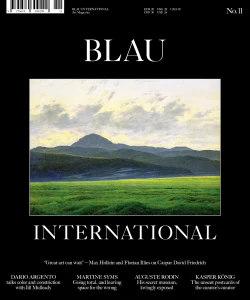
“That day, we started the conversation that eventually led to the very personal essay Meyer has contributed to this issue of BLAU International. Recounting a brief history of a phenomenon he’s coined the ‘Gay Man’s Castle,’ Meyer insists on the transformative power of personal taste. He shows us how the homes of creatives, how their collections, how even the ceilings above their deathbeds can narrate histories of repression and liberation alike. And how paying tribute to the men who build those ‘castles’ far too often means remembering those we’ve lost. If you ever meet Meyer, you might thank him for this. But never, ever bring up Wuppertal. It will surely harsh his vibe.”
-
“Both the Parthenon and Cinderella Castle try to physicalise myths, a means of building legacy that manifests as a fairytale and influences our perspectives of reality. It’s rare to find these kinds of wild optical manipulations employed in contemporary buildings, but it’s all too easy to see a similar desire to push a narrative through colossal and eye-catching buildings.”
-
“Tackiness may require unabashed love, but it also rewards those who get the references—and the current mood. As Karl Lagerfeld once proclaimed, ‘Trendy is the last stage before tacky.’ The tack-o-meter is constantly adjusting. It moves with the times, chewing up the past to recalibrate our present tastes.”
-
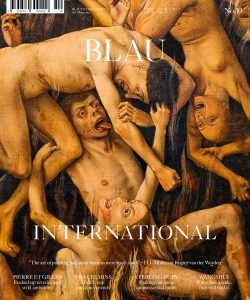
“Recently, the New York Times published a story about BLAU International’s headquarters in Berlin. We only realized how much it must have struck a chord with the readers when the Times subsequently posted one image from the story on their Instagram account. ‘Is it a magazine—or is it a cult?’ was one of the more frequently asked questions the readers seemed to have, the most probable answer being: both.”