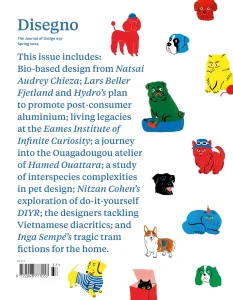
“The emotional bond between owner and pet is often, perhaps to some degree always, bound up in anthropomorphic projections.”
Kyle Thomas Hemingway: The ephemera edit
An ongoing digital archive of 1,429 items (and counting) proving that I read, I saw, and I actually paid attention.
Collection
Disegno
-
-
“Both the Parthenon and Cinderella Castle try to physicalise myths, a means of building legacy that manifests as a fairytale and influences our perspectives of reality. It’s rare to find these kinds of wild optical manipulations employed in contemporary buildings, but it’s all too easy to see a similar desire to push a narrative through colossal and eye-catching buildings.”
-
“Why do we still fail to realise that difference adds depth and complexity, creating a more resilient system for all?”
-
“Fake bags can be understood as providing a commentary on the intricate history of cultural appropriation and commerce.”
-
“Outlining historical connections in colour can only get you so far—there’s an element that’s missing if you don’t experience it in person. In honour of this, the exhibition is itself an exercise in experimenting with colour, with the Vitra Design Museum´s collection acting as the material that Marcelis is manipulating. The museum’s team are happy to give themselves up to this process, partly as it has allowed them to re-discover ‘objects that were previously virtually unknown or at least somewhat hidden,’ as Steinmüller describes it, and provide these objects with ‘the space to glow.’”
-
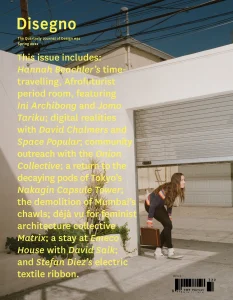
“Like a time-capsule, the photographs of the interiors of the Nakagin Capsule Tower units—shot by Noritaka Minami over the course of many years—transport me back in time to the Tokyo of the 1970s, where I spent my childhood. More immediately, they take me slightly less further back, to a time eight years ago when I rented a unit in Tower B.”
-
“To not be able to go there for the opening is very difficult. On the other hand, it’s a building for the people of Hong Kong and it’s nice that they will be the most important people at the opening. This period is probably the first time in history where buildings are being opened without their architects present, and maybe that’s an opportunity. This is a strong sign to the community and the people of Hong Kong. ‘Here, this building is for you. Enjoy it.’”
-
“I first saw the Bourse de Commerce, really saw it, in April of this year, but by that point I had been living in Paris for more than six years. I’d visited the Louvre of course, a minute or so stroll towards the river, and the Musée des Arts Decoratifs just down the street. I had seen shows at the Centre Pompidou, a few minutes to the east, and I had been, grudgingly, to the vast mall at Les Halles right next door many times when a trip to Muji was unavoidable. I’d even met friends after work at Iovine’s pizzeria one bitingly cold winter’s evening, almost directly opposite the Bourse’s grand entrance, but still, I’d never seen it. It was just one more pile of haughtily beautiful pale Parisian stonework that my eyes slid over and my brain failed to register.”
-
“While some art forms seem well suited to be experienced in a digital format, furniture is a more challenging proposition—to state the obvious, its key function is to be physically used. The chairs we sit on, the desks we work at, the cupboards we store things in, the lamps we read by: while this transactional relationship is far from the only function furniture fulfils, it is the most common, even when furniture is sold at high prices at auction or via design galleries. Even Marc Newson’s Lockheed Lounge (the current record holder for the most expensive furniture object sold by a living designer at £2.4m) can be used for reclining—however tentatively one might choose to do so.”
-
“The staples of the fashion industry have not been immune. The fashion show, the launch and the press trip: all have been cancelled or reconsidered, like so many other events.”
-
“But it is perhaps Andrew Berman’s understated contribution that is the highlight: a mysterious prism clad in white polycarbonate, the interior painted black, with only a small opening letting through a little light, but otherwise leaving the visitor in the dark. It creates a kind of confrontation with the self, an idea with a long religious tradition, and Monsignor Tighe explains that the chapels aim to induce transcendence as a way to create a shared experience for the faithful and non-believers alike. ‘Beauty and art, at their best, have the capacity to invite people to go in a little deeper, to break with what Cardinal Ravasi calls the scourge of superficiality,’ he says. ‘It creates a space for reflection, for silence, to get in touch with what’s happening in their own heart and we would believe that allows the person to be in contact with God, whether he or she believes in God.’”